Types of investments
This guide walks through the common types of investments — what each one is, what kind of return it produces, and what to watch out for. It is the third of three beginner guides, following Why invest? and What are investments?. Each type maps to a portfolio category in the app, so you can track any mix of them side by side.
Educational content, not advice. These guides explain general concepts so the app's features make sense. They are not investment advice, and nothing here is a recommendation to buy or sell anything. Investments can lose value.
At a glance
| Savings accounts | Interest | Very low | Immediate | Savings |
| Term deposits & bonds | Interest | Low | Locked until maturity | Deposits & Bonds |
| Stocks, ETFs & funds | Dividends + price growth | Medium–high | High | Brokerage |
| Cryptocurrencies | Price growth | Very high | High | Crypto |
| Real estate | Rent + price growth | Medium | Very low | Properties |
| Lending (P2P, private loans) | Interest | Medium–high | Low | Loans |
| Pension schemes | Fund growth | Low–medium | Locked until retirement | Pension |
| Cash | — | None (but inflation) | Immediate | Cash |
| Anything else of value | Varies | Varies | Varies | Other Assets |
Savings accounts
The simplest starting point: money at a bank earning modest interest, available any time. Rates rarely beat inflation, so savings are best for the emergency cushion and short-term goals rather than long-term growth. In the app, a Savings portfolio generates its interest entries automatically from the rate and schedule you set.
Term deposits and bonds
You lend money for a fixed period at a fixed rate — to a bank (term deposit) or a government or company (bond). Predictable interest, principal back at maturity. The trade-offs: money is locked up, and the rate is only as good as the borrower's promise. Deposits & Bonds portfolios track each deposit's principal, rate and maturity, including auto-renewal chains.
Stocks, ETFs and investment funds
Buying shares makes you part-owner of a company: you earn dividends and gain (or lose) as the price moves. Individual stocks swing hard; funds and ETFs hold hundreds or thousands of companies in one purchase, which is why broad, low-cost index ETFs are the usual beginner recommendation — instant diversification, tiny fees. Historically the strongest long-run growth of the mainstream types, with the biggest interim drops. Track these in a Brokerage portfolio, where holdings get live prices, P&L and dividend history — see the Holdings & assets guide.
Cryptocurrencies
Digital assets like Bitcoin and Ethereum. No underlying cash flow — returns come purely from price change, and prices are extremely volatile: drops of 50%+ within a year have been routine. Treat crypto as a high-risk satellite, not a foundation; a common guideline is to only hold what you could afford to lose entirely. Crypto portfolios work like brokerage ones, with live prices and P&L.
Real estate
Property you own — typically rented out for income while (hopefully) appreciating. Tangible and income-producing, but expensive to enter, slow to sell, and concentrated: one flat is one asset in one city. Properties portfolios track purchase cost, a value history you update over time, and rent collected.
Lending: P2P platforms and private loans
Crowdlending platforms and person-to-person loans pay attractive interest because the risk is real — borrowers default, and platforms can fail. Recovery of a bad loan can take years. The Loans category tracks each loan's principal, rate, maturity and status (active, late, defaulted, recovered, repaid), so the risk stays visible.
Pension schemes
Retirement vehicles — employer plans, state-linked pillar funds, private pension funds. Contributions are usually tax-advantaged and locked until retirement age, invested in diversified funds under the hood. Pension portfolios track fund units or balances, and some national schemes can be imported directly — see the Importing guide.
Cash and everything else
- Cash portfolios are a plain balance — a current account or cash envelope. No return; the point is completeness, so your net worth is honest.
- Other Assets covers valuables that don't fit above — vehicles, collectibles, art, business stakes — valued manually or by quantity × price.
Mixing them: allocation
Most portfolios that survive decades are a blend: growth assets (stocks, property) doing the heavy lifting, stable assets (deposits, savings) cushioning the falls. The right blend depends on your time horizon and temperament — the app's risk-profile questions (on your dashboard when starting out, or from your profile page) produce an educational starting mix, and allocation views show how your actual holdings compare.
A blend looks like this — one set of answers, turned into percentages across the categories above:
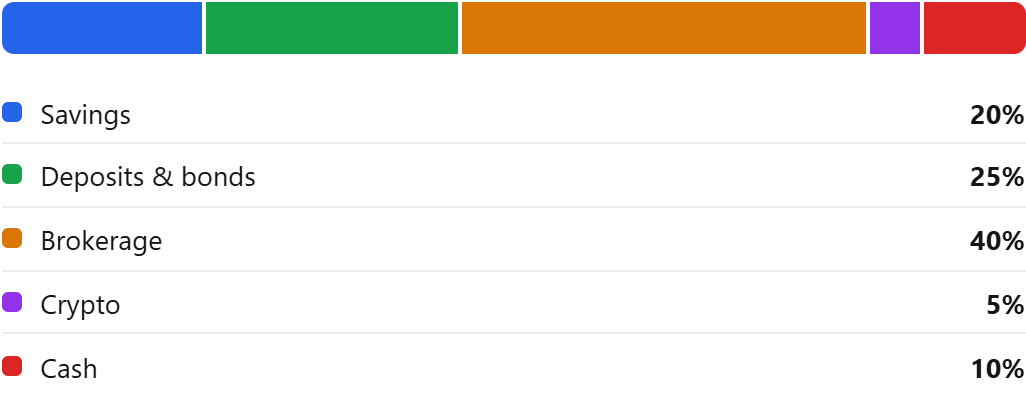
 One example blend, produced by the risk questionnaire — not a recommendation.
That is the output for one particular set of answers — a long horizon paired with a cautious temperament — and not a recommendation. Different answers produce a different mix, and yours is yours to decide. What is worth taking from it is the shape rather than the numbers: the largest single share in broad growth assets, and a substantial cushion in things that hold their value when markets fall. Note what is absent — this blend holds no crypto at all. The questionnaire only ever suggests it to the most adventurous answers, and even then keeps it to a small corner.
To see any of these in the app, create a portfolio of the matching category from the dashboard — the Dashboard guide covers how.