Why invest?
This guide is for people who are new to investing. It explains why putting money to work matters, what realistic expectations look like, and how to take a first step without taking risks you don't understand. It is the first of three beginner guides — the others are What are investments? and Types of investments.
Educational content, not advice. These guides explain general concepts so the app's features make sense. They are not investment advice, and nothing here is a recommendation to buy or sell anything. Investments can lose value.
Cash quietly loses value
Prices rise over time — that's inflation. Money sitting in a current account buys a little less every year. At 3% yearly inflation, €10,000 of today's money has the buying power of roughly €7,400 after ten years. The money is still "safe" in the sense that the number doesn't change, but what it can buy shrinks.
Investing is the usual answer to this: owning things that tend to grow, or that pay you income, so your savings at least keep pace with prices — and ideally outrun them.
Amounts are illustrative. Examples in these guides are shown in euro. The same arithmetic holds in any currency, and the app tracks whichever ones you actually use.
Compounding: returns earn returns
When your investments earn a return and you leave it invested, the next year's return applies to a slightly bigger amount. Over short periods this barely matters; over decades it dominates.
| 1% (savings-like) | ~€11,000 | ~€12,200 | ~€13,500 |
| 4% | ~€14,800 | ~€21,900 | ~€32,400 |
| 7% (stock-market-like, long-run average) | ~€19,700 | ~€38,700 | ~€76,100 |
The shape is the point. Here is that last row as the app draws it — €10,000 left alone at 7%, with every year's interest reinvested. Notice how little happens in the first decade, and how steep the line becomes in the last one:
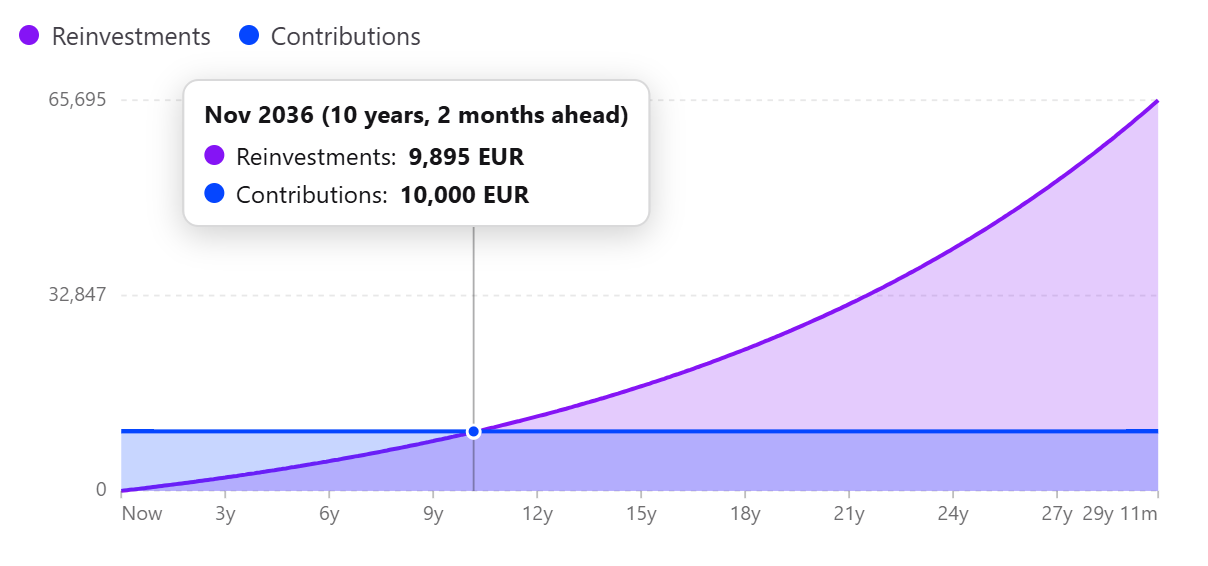
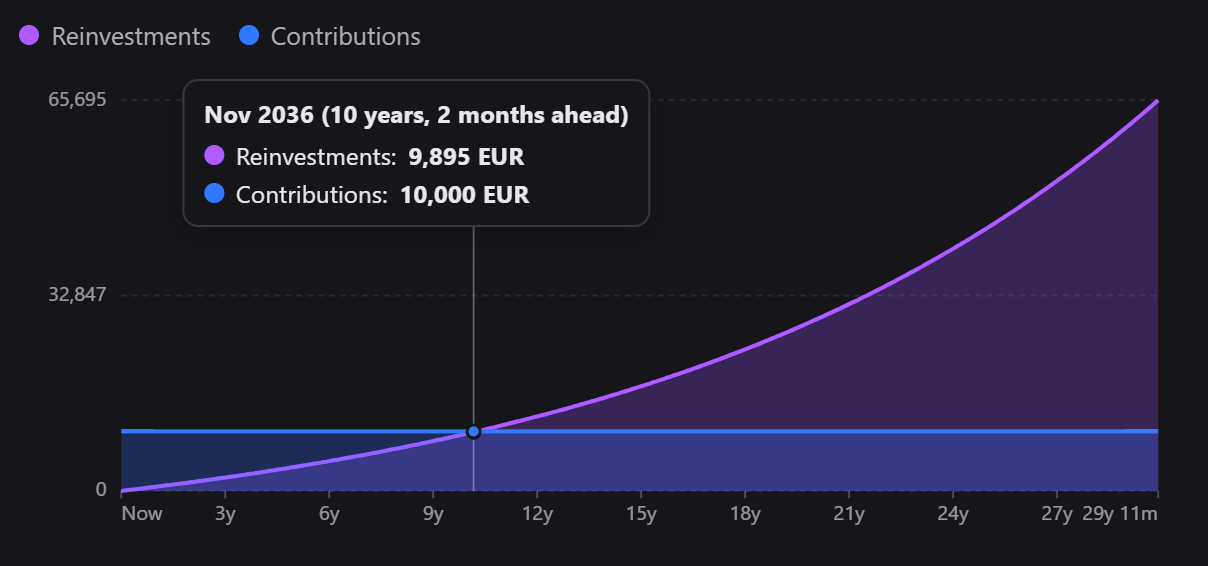 A lump sum: €10,000 paid in once, then left alone for 30 years.
The cursor in that picture is parked on a moment worth understanding. Around year ten the purple line — money the investment earned and put back to work — crosses the blue one, which is the €10,000 you actually paid in. Before that point most of what you own is your own money. After it, most of what you own was produced by the investment. Nothing changes on that date; it is simply where the slow half ends and the steep half begins.
Most people don't have a lump sum to leave alone, though — and they don't need one. Here is the same 7%, starting from €500 and adding €200 a month:
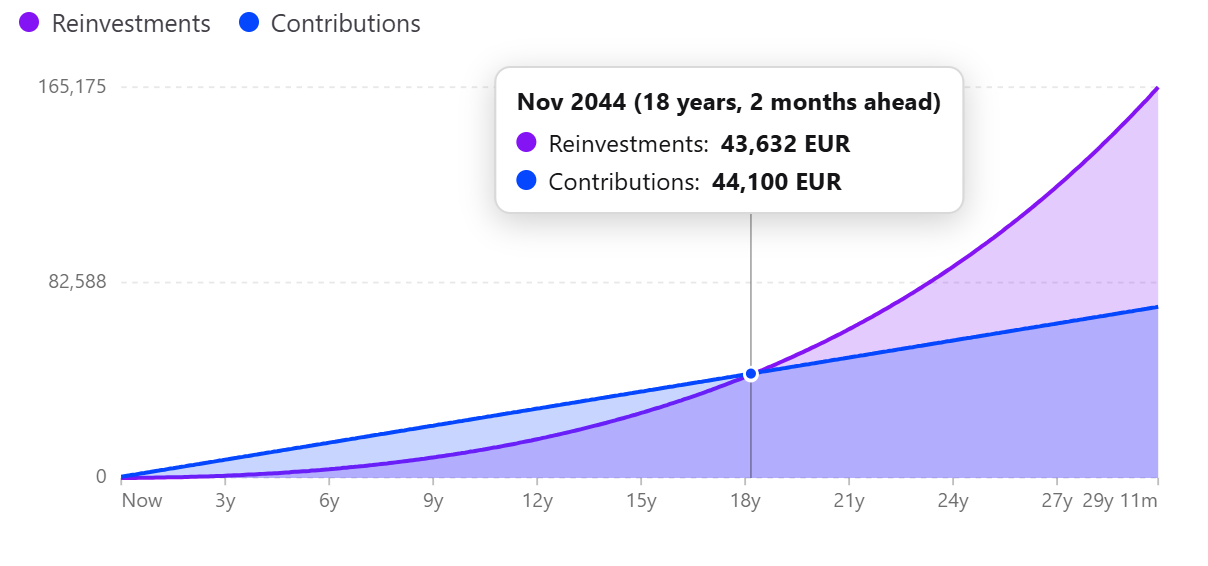
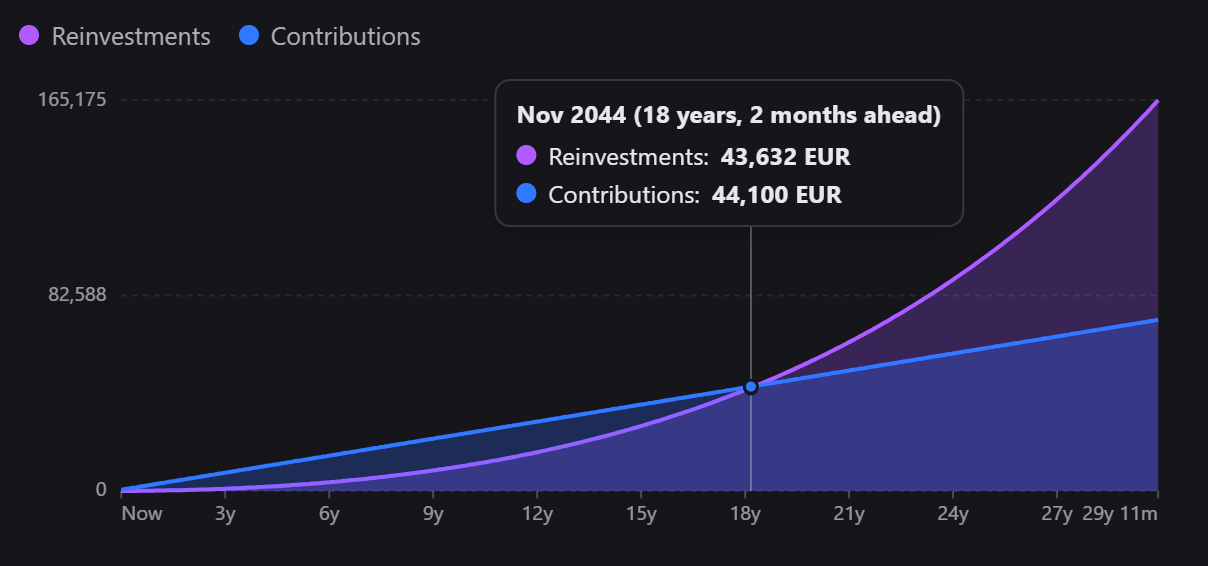 A monthly habit: €500 to open, then €200 every month. Note the rising blue line.
The crossover still arrives, just later — around year eighteen rather than year ten — because every new deposit raises the bar your returns have to clear. What that patience buys is scale: the monthly habit reaches about €237,000 over the thirty years, against €76,000 for the €10,000 left alone. Roughly €72,000 of that is money you paid in. The rest the investment made.
Any projection in the app can be inspected this way: hover anywhere along the line to read the exact figures for that month, which is where all of these numbers came from.
Two things follow from compounding:
- Starting early beats starting big. Time invested matters more than the amount you begin with.
- Regular contributions add up. Steadily adding a fixed amount each month is how most people build wealth — not one lucky pick.
You can see this effect on your own numbers with the app's Planning & projections tools, which project a portfolio forward under different return assumptions.
Risk and time horizon
Higher expected returns come with bigger swings along the way. Stocks have historically returned more than savings accounts, but they can drop 30–50% in a bad year. Whether that matters depends on when you need the money:
- Money you need within a couple of years (an emergency fund, a planned purchase) belongs in safe, liquid places — savings or short term deposits — where a market drop can't hurt it.
- Money you won't touch for 10+ years (retirement, long-term goals) can afford to ride out downturns, which is where higher-return investments earn their keep.
A common rule of thumb: build an emergency cushion of a few months' expenses before you invest anything, then invest what's left over according to your horizon. Keep that cushion in an instant-access savings account rather than a current account — it stays available the moment you need it, and earns at least some interest instead of none. It probably still won't outpace inflation, and that is the accepted trade for money you might need tomorrow.
Taking the first step in the app
You don't need money on the line to learn:
- Explore the demo portfolios on your dashboard — sample brokerage, deposits and property data you can poke at freely.
- Answer the risk-profile questions (offered on the dashboard when you start, or later from your profile) to get an educational starting mix that matches your situation.
- When you have real accounts, create a portfolio for each — or import your broker's statement — and let the app track the whole picture. The Dashboard guide shows how.
Next: What are investments? explains the mechanics — where returns actually come from.